Category: Startup Ideas
Starting a business is exciting, but spending money too early can be risky. Many beginner founders fall in love with an idea and quickly start building a website, hiring people, buying tools, or creating a product. Later, they realise that customers do not really need it.
It is important to validate a startup idea before you launch.
Validation means:
- checking if your idea solves a real problem and if people are willing to use or pay for your solution.
- You do not need a big budget to test your idea.
- You only need the right questions,
- honest feedback,
- A simple way to test demand.
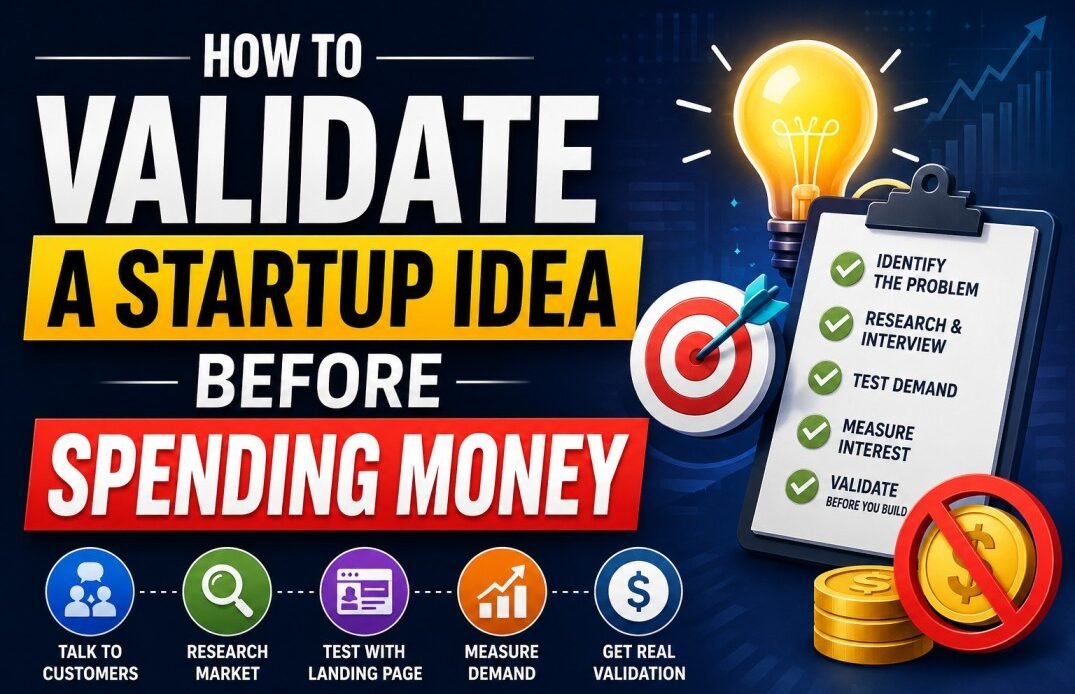
This guide will help beginner founders learn how to validate a startup idea before spending money.
What Does It Mean to Test a Startup Idea?
To validate a startup idea means to prove that your business idea has real demand.
- Solves a real customer problem
- Offers clear value to your target audience
- Creates enough interest for people to take action
- Encourages potential customers to sign up, ask questions, or request details
- Has the potential to make people pay for your solution
The goal is simple:
Find out if people want your idea before you spend serious money.
Why You Should Validate Before Spending Money
Validating your startup idea before spending money helps you make smarter business decisions. It gives you early proof that people need your solution and reduces the risk of building something no one wants.
Here are the key reasons why every beginner founder should validate a startup idea before launch:
1. It Reduces Business Risk
Many startups fail because founders invest in an idea without checking real market demand. Validation helps you understand whether your idea solves a real problem before you spend money on product development, branding, inventory, or marketing.
2. Understand Customer Needs Better
When you talk to potential customers, you learn what they actually want. You may discover their biggest problems, buying behaviour, budget, and expectations. This helps you shape your startup idea in the right direction.
3. Save Time and Reduce Cost
Building a full product without testing demand can waste months of work and a lot of money. Validation helps you avoid unnecessary spending and focus only on what matters at the early stage.
4. Improves Your Product Before Launch
Early feedback can show you what needs to be changed. Customers may want a simpler solution, a better feature, or a different price. This allows you to improve the idea before launching it to a larger audience.
5. It Gives You More Confidence
When real people show interest, sign up, ask for pricing, or agree to test your offer, you get confidence that your idea has potential. This makes it easier to move forward with a clear plan.
6. Build according to Real Market Demand
A successful startup should not be built on guesswork. When you validate a startup idea first, you build based on real market demand, customer feedback, and practical evidence.
Start With a Real Problem
Every strong startup begins with a real problem. Before you think about your logo, website, or app, ask yourself what problem you are solving.
A good problem is something people face often. And want a solution.
Ask yourself these questions:
- Who has this problem?
- How often do they face it?
- How do they solve it now?
- Are they already paying for a solution?
- What makes current solutions difficult?
If people are already spending money or time to solve the problem, that is a good sign. It means the problem matters.
Know Your Target Customer
You cannot validate a startup idea properly if your target customer is “everyone.” A startup needs a clear audience.
The more specific your audience is, the easier it becomes to understand their needs.
review and find common complaints. If freelancers say that current tools are too complex or expensive, you can create a simpler and more affordable bookkeeping service designed only for freelancers and solo business owners.
Talk to Potential Customers
One of the best ways to validate a startup idea is to speak with real potential customers. These should be people who match your target audience.
Do not try to sell at first. Try to understand their problem.
Ask simple questions such as:
- How do you handle this problem now?
- What is the hardest part?
- Have you paid for any solution before?
- What do you dislike about current options?
- What would make your life easier?
If many people describe the same problem, that is a useful signal. It means your idea may have business potential.
First,Test If People Will Pay
Free interest is good, but payment is stronger proof. If people are willing to pay, it means the problem has value.
You can test payment with a small offer, early access price, beta plan, pre-order, or paid pilot.
You do not need hundreds of customers at the start. Even a few paying users can show that the idea has potential.
Use Feedback to Improve the Idea
Validation is not only about getting a yes or no. It is also about learning.
Customers may want a different feature. Sometimes, you might find that your target audience is wrong. In some cases, you may learn that people need a cheaper or simpler version.
Do not ignore negative feedback. It can save you from a bad decision. A smart founder listens carefully and improves the idea before spending more money.
Signs Your Startup Idea Is Validated
Your idea may be ready for the next step if real people are showing real interest.
Good signs include:
- People sign up for your waiting list
- Potential customers ask for pricing
- Users agree to test your MVP
- Someone pays for early access
- Businesses request a demo
- Users share your idea with others
- People keep using your simple version
Final Thoughts
Before you spend money on your startup, take time to validate your startup idea. It is one of the smartest steps for beginner founders.
Start with the problem. Understand your target customer. Study the market. Talk to real people. Create a simple landing page. Build a small MVP. Test if people are willing to pay.
You do not need a perfect product to begin. You need proof that people want what you are planning to build.
A startup idea becomes stronger when it is tested in the real world. Validation helps you launch with more confidence and less risk.